RU

Know your lynx!
1. Canadian lynx (Lynx canadensis)
Area: Alaska, Canada, northern United States.
2. lynx (Lynx pardinus)
Range: Portugal, Spain. Size: smaller than Canada.
3. Bobcat (Lynx rufus)
Area: United States, parts of Canada and Mexico.
4. Eurasian lynx (Lynx lynx)
Area: Europe to Asia.
Know your wolf!
Areal: North America, Europe, Asia (pink zones on the map).
Medium size: 1.22-2.01 m in length.
Average weight: 54.4-81.65 kg.
Habitat and nutrition: Tundra, forests, meadows, deserts; carnivorous - deer, moose, bison and small mammals.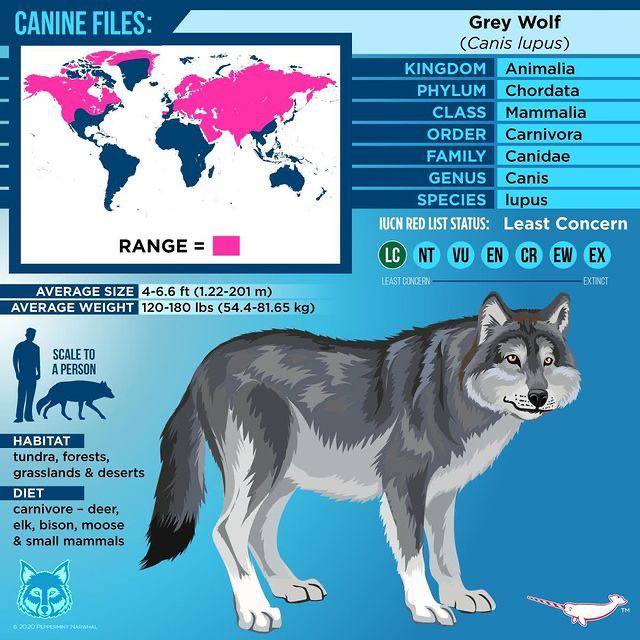
Know your Wild Cat!
The Wild Cat (Felis silvestris)
· Common name: Wild cat (European wild cat, forest cat)
· scientific name: Felis silvestris
· Status in the IUCN Red Book: Least Concern (Least Concern)
Dimensions:
· Body length: 43-91 cm
· Tail length: 23-40 cm
· Average weight: 5–8 kg
They live in a variety of places:
· Deserts
· Semi-arid regions
Savannah
· Shrubbery steppes
· Open forests
· Hilly and rocky territories
· Mixed forests
They eat mainly small animals.:
· Small rodents
· Birds.
· Rabbits.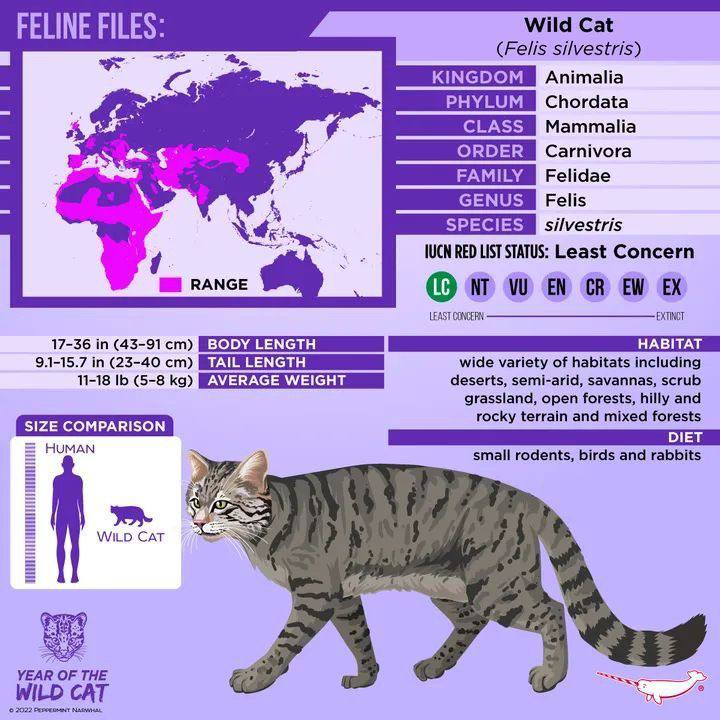
Know your fox!
Red fox (Vulpes vulpes) Not always red, maybe:
Brown, black, silver, fire-ice, champagne, black-brown, marble.
Areal: North America, Europe, Asia, Africa, Australia (expanding due to climate and man).
Medium litter: 6 cubs.
Habitat and nutrition: Forests, meadows, mountains, deserts; omnivorous - rodents, birds, eggs, reptiles, insects, fruits, plants.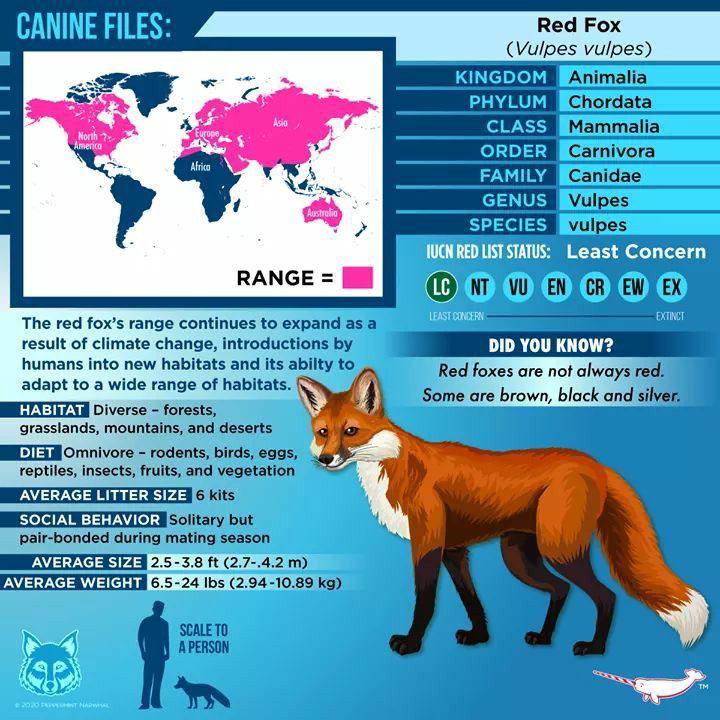
Know your Tiger!
Status: Endangered (Endangered) (Threatened)
1.The Continental Tiger
Panthera tigris tigris
Includes subspecies:
• Amur (Siberian) tiger
• Bengal tiger
• Indochinese tiger
• Malayan tiger
• The South China Tiger. functionally
The Caspian Tiger. die-off
Features:
• Larger than island tigers
• More massive body, larger head
Adaptation to cold and temperate climates (especially Amur)
2. Tiger of the Sunda Islands
Panthera tigris sondaica
Includes:
• Sumatran tiger. single-living
Bali-- die-off
• Java die-off
Features:
• Smaller in size
• Lighter, "burning" body
• Dark, dense stripes
• Adapted to the jungle and island environment
Continental Tiger:
up to 3.3 m with a tail, 180-300 kg (Amur - record holders)
Sumatran Tiger:
2.2–2.5 m, 100–140 kg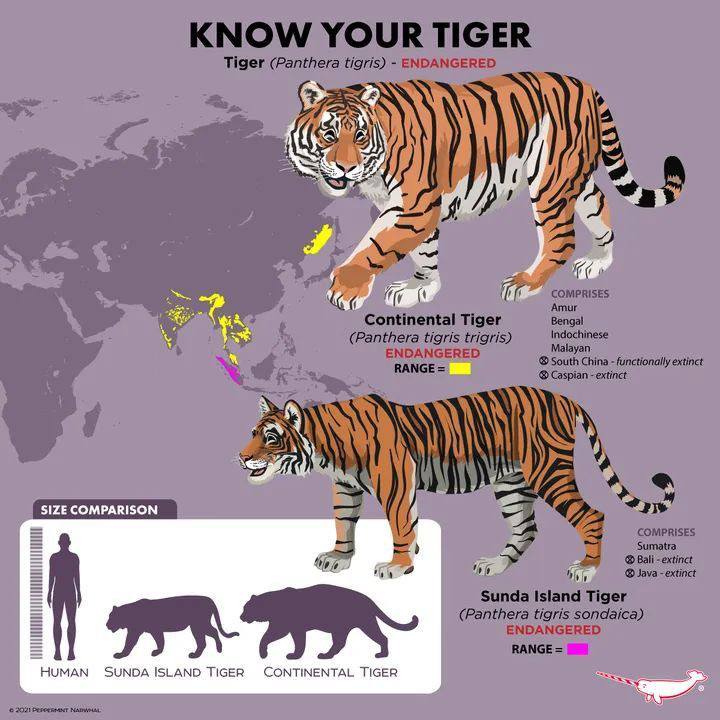
Know your Caracal!
Caracal (Caracal caracal)
• Status.: Least Concern (Least Concern)
• arealSelected pink - almost all of Africa, the Middle East, parts of Central and South Asia.
• Features:
Characteristic long black tassels on the ears, a slender body, adapted to open landscape and hunting by jumping.
⸻
African Golden Cat (Caracal aurata)
• Status.: Vulnerable (vulnerable species)
• areal: Much narrower, mostly moist rainforests of Central Africa.
Color legend:
• pink - modern range
• purple - possibly extinct
• blue-colored Presumably existing
• Features:
A more stocky, spotted or monochromatic, secretive forest species.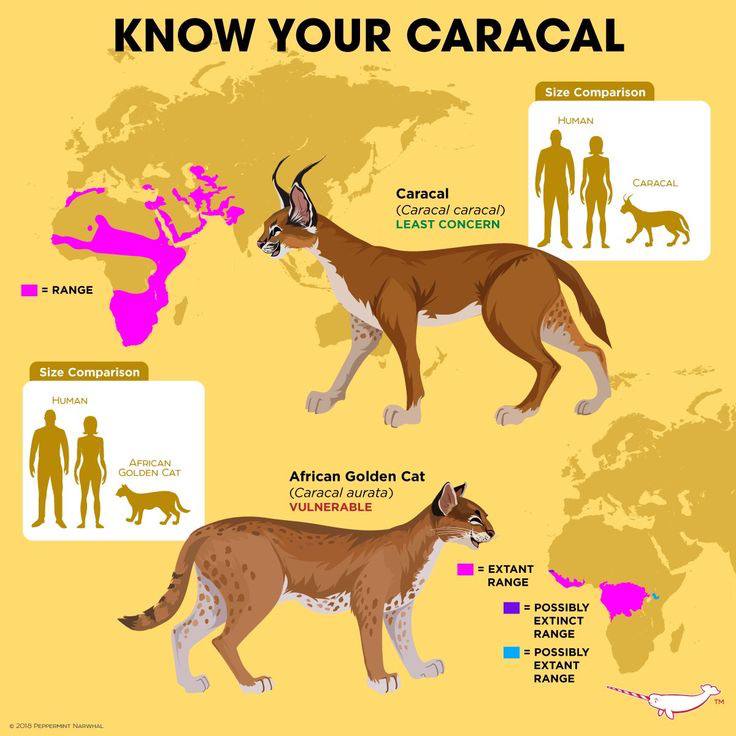
Know your cougar!
• Scientific name: Puma concolor
• Other names: cougar, mountain lion, panther, catamount, deer tiger, red tigerThere are many names because the area is huge and different cultures have given their names.).
areal
• Red marked the main area: from southern Canada through the United States, Central America and almost all of South America to Patagonia.
• Dark red - possible / historical range
The puma is one of the most widespread land predators in the Western Hemisphere.
Size
• Body length is usually 1–1.8 m (tailless)
• tail another 60-90 cm
• height at the withers about 60-75 cm
• Visually: Below a person, but very long and powerful
Status of preservation
• Least Concern ("Least Concerns") - the species as a whole is not endangered
But locally, populations can decline due to habitat loss and human conflict.
It's important to understand
• The puma doesn't roar like lions and tigers - it purrs, hisses.
• It is a solitary, extremely secretive and very plastic predator.
• It's a great jumper.up to 5-6 m in height and up to 12 m in length)
• It often symbolizes quiet power, control, and secrecy.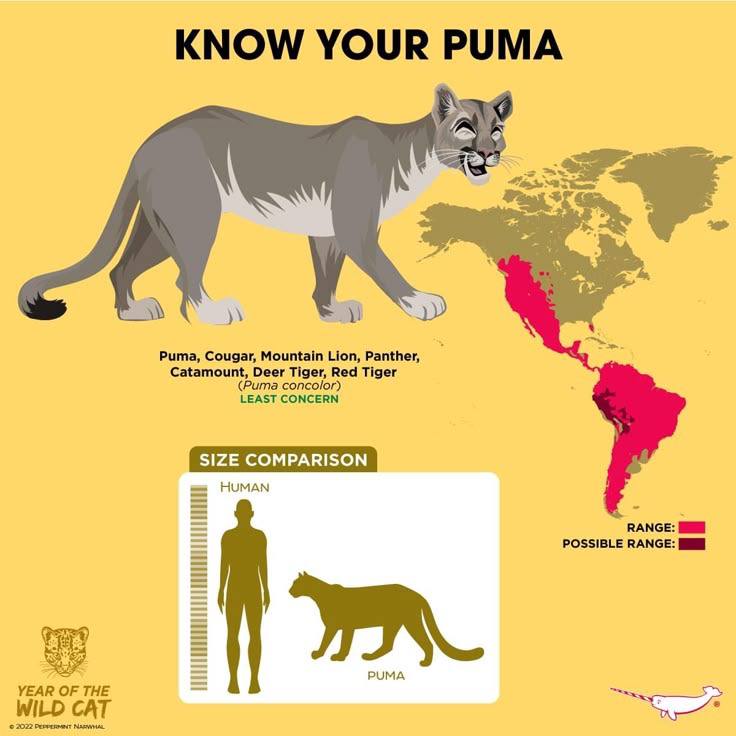
Know your Panther.
• The Black Panther is not a separate species.
This is a melanistic form of color (melanism) in some large cats.
• Melanism is an excess of melanin pigment, which makes the coat look almost completely black.
It's the opposite of albinism.
The diagram shows two pairs of animals:
• Melanistic coloration (black)
• Melanistic jaguar - Panthera onca
• Melanistic Leopard – Panthera Pardus
If you look closely in good lighting, they still show spots — they are simply “drowned” in a dark background.
• Ordinary coloring
• Jaguar - Panthera onca
• Leopard - Panthera pardus
security statuses:
• Jaguar – Near Threatened (close to vulnerable)
• Leopards are Vulnerable (vulnerable).
Important detail
People often call any big black cat a “black panther,” but biologically it’s almost always:
• Black Leopard (Africa, Asia)
• Or a black jaguar (America).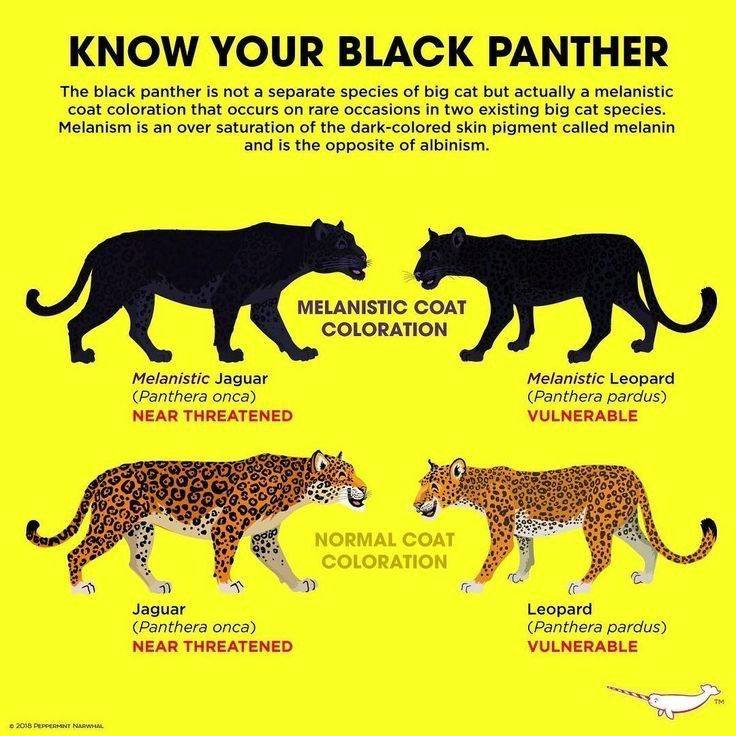
Know your Capybara.
1. The ordinary capybara (Hydrochoerus hydrochaeris)
- the same "meme", the largest rodent in the world
It is distributed almost throughout South America.
- status: Least Concern (not threatened)
2. Small capybara (Hydrochoerus isthmius)
- smaller in size.
– lives locally: Panama, Colombia, northwest South America
Status: Data Deficient (Data Deficient)too little data)
What's important and interesting
• Pink shows the area.
You can see that in an ordinary capybara it is huge, and in a small one it is very limited.
• Comparison of sizes with humans
Even the small capybara is still quite large - just more compact than the "classic".
• Many people do not know that capybaras are two species, and consider them to be one animal.
• Data Deficient is not “rare” but “poorly studied”: it may be more vulnerable than it seems.
Funny fact.
The small capybara used to be considered a subspecies, and only relatively recently has it been established as a separate species, so this is an example of how science is still mapping the world.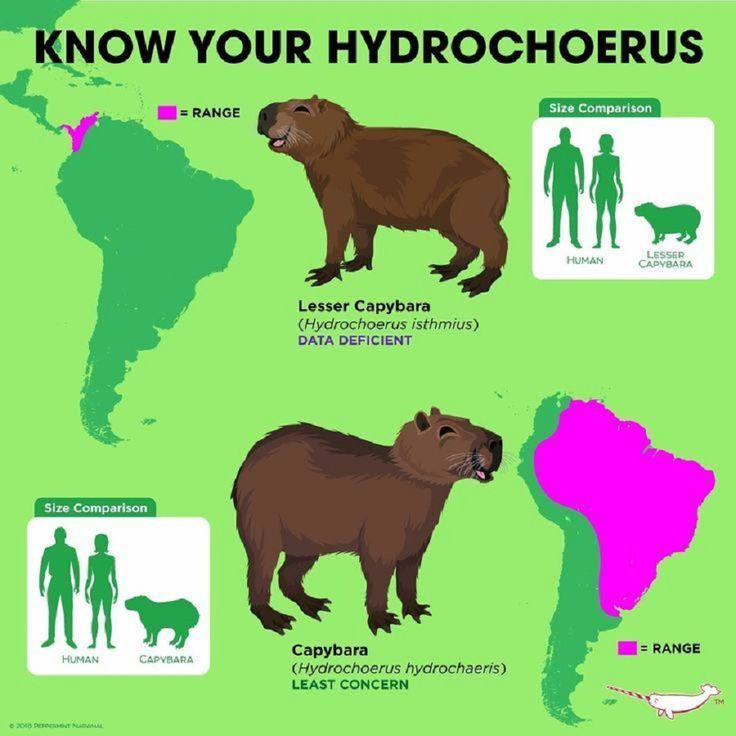
You know, your elk.
Moose is one of the largest representatives of the deer family.
• View: Moose / Eurasian moose
• Latin name: Alces alces
• Conservation Status: Least Concern – “least concern” (the species is widespread and not endangered).
Distribution map
The purple color on the map shows the range of the moose. It covers:
• Northern Europe (Scandinavia, Baltic States, Russia)
• siberia
• Canada
• north
• northerly regions of Eastern Europe
That is, elk is a typical animal of the northern forests (taiga and boreal forests).
A little bit of facts.
• Growth at withers: up to ~2.1 m
• Weight: 300–700 kg (male males are larger)
• Span of horns: up to 1.8-2 m
• Only males have horns and they are shed annually.
Why are the horns so huge?
Moose horns have a spade-shaped shape, and they're used:
• mating-time
• power-proof
• It's a visual signal of dominance.
The moose is so powerful that it's feared by all the animals in the forest, including bears, and for humans, encountering moose is also sometimes more dangerous than meeting a bear. 
Know your maned wolf.
(Maned Wolf (Latin: Chrysocyon brachyurus))
• The light yellow area shows the habitat of the animal in South America.
The maned wolf is the largest member of the canine family in South America.
Where he lives.
The area on the map includes mainly:
• Brazil
• paraguay
• Bolivia
• Argentina
• occasionally Uruguay
Most often he lives in savannas, pampas and open steppes, rather than in dense jungles.
Interesting Features of an Animal
• Despite its name, it’s not a real wolf – it’s the only species of Chrysocyon.
• It has very long legs to see prey in tall grass.
• Growth at the withers can reach ~90 cm - because of this, it looks like "on stilts."
• It eats not only meat - up to 50% of the diet is fruit (for example, "wolf apple").
Interesting fact.
It looks like a mix:
• foxes
• wolf
• and even a little deer because of the long legs.
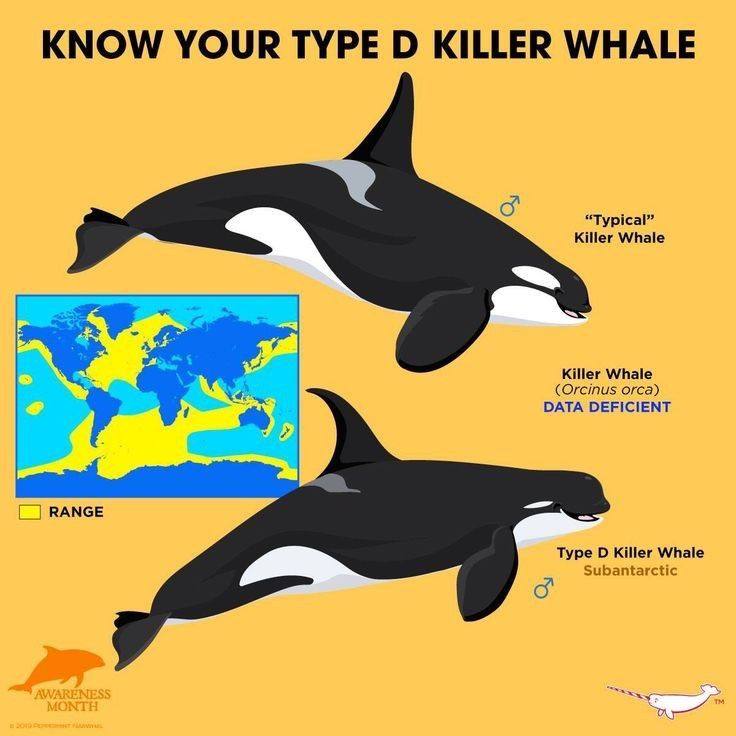
Know your killer whale.
And you knew. In addition to the usual, there is also a type D orca (sub-Arctic).
Type D It is different from the “normal” orca:
• phosphorus,
• rounder-head,
• narrower-pointed dorsal fin.
Scientists want to separate them into a separate form.
The map shows the total range of killer whales.
We don't have much data to tell if they're threatened by a shrinking species.